
When businesses start considering offshore hiring, the conversation often begins with workload.
We have too much to do.
The team is stretched. The founder is still involved in things they shouldn't be. Tasks are piling up and everyone could use another pair of hands.
So the natural response is:
“Let's hire someone to help.”
Sometimes, that's exactly what's needed.
But there's another question worth asking before writing the job description:
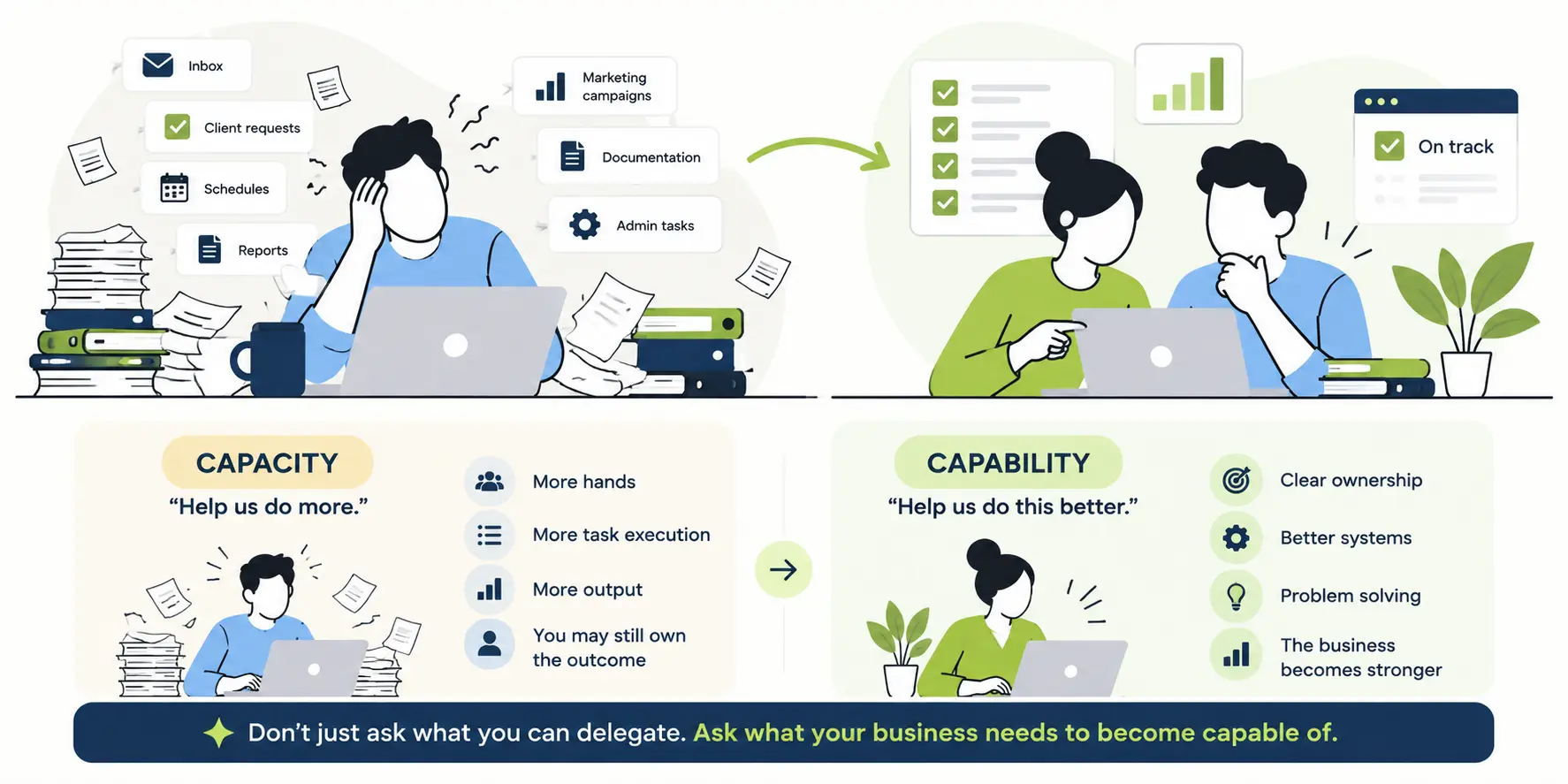
Does your business need more capacity, or does it actually need more capability?
They sound similar.
They're not.
And understanding the difference can completely change the kind of person you hire.
Capacity helps you do more of what you're already doing
Capacity is about volume.
Your business already knows what needs to happen. The process exists. The work simply exceeds the amount of time your current team has available.
Perhaps your inbox has become unmanageable.
Your marketing team has more campaigns than it can execute.
Customer enquiries are increasing.
Invoices need processing.
Research needs completing.
There are dozens of recurring administrative tasks consuming hours every week.
In these situations, adding capacity makes sense.
You already have the machine.
You need another person to help keep it running.
There's nothing wrong with hiring for capacity.
The problem is when every offshore role is designed this way by default.
Capability changes what your business can do
Capability is different.
Instead of asking someone to simply absorb work, you're bringing in a person who can own an area of the business that currently isn't being handled well enough.
Maybe marketing isn't struggling because there are too many tasks.
Maybe it's struggling because nobody owns the operational side of it.
Campaign deadlines move. Assets need chasing. The CRM becomes inconsistent. Reports only happen when somebody remembers.
Adding another pair of hands might help temporarily.
Adding someone who can own marketing operations solves a different problem.
The same applies elsewhere.
An overwhelmed founder might think they need a virtual assistant.
What they may actually need is an Operations Coordinator who can understand recurring workflows, coordinate moving pieces, document processes and gradually remove the founder as the default point of escalation.
A business struggling to understand its numbers might think it needs someone to update spreadsheets.
What it may need is someone who can take ownership of finance administration and recurring reporting so leadership has dependable information when decisions need to be made.
That's capability.
You're not simply distributing tasks differently.
You're strengthening what the business is able to do.
The difference often comes down to ownership
One of the easiest ways to recognise the difference between capacity and capability is to look at who still owns the outcome.
Imagine you've hired someone to help with a weekly report.
If you still have to:
- Remember that it's due
- Tell them what information to collect
- Chase missing data
- Check whether it has been completed
- Correct the same recurring issues
- Interpret everything yourself
You've probably added capacity.
Someone else is doing part of the work, but you still carry the mental load.
That ownership does not happen instantly. It can be built deliberately through the WATCH → DO → OWN → IMPROVE onboarding framework.
Capability starts to emerge when the person understands what the report is for, knows where the information comes from, notices when something looks wrong, follows up where necessary and makes sure the finished report is ready when the business needs it.
You should still know what's happening.
You just shouldn't have to be the person making everything happen.
Why this matters even more when hiring offshore
Traditional outsourcing has often been built around tasks.
Businesses document the process, send the work somewhere with lower labour costs and measure success largely through efficiency.
That model has created enormous industries.
But it has also shaped how many businesses still think about offshore professionals.
The question becomes:
“What can we send offshore?”
Instead of:
“What could someone offshore own?”
That distinction matters.
When the role is designed around a list of disconnected tasks, it's easy for the person doing the work to remain outside the real operation of the business.
They wait for instructions.
They complete the work.
They send it back.
The client checks it.
Then the cycle starts again.
The business has technically delegated work, but hasn't necessarily reduced the amount of management, thinking and coordination required from the people who were already overloaded.
The cheapest hire can become an expensive management problem
Cost matters.
Every business has a budget, and one of the advantages of global hiring is that geography can give SMEs access to experienced professionals at a cost structure that may be difficult to achieve locally.
But cost shouldn't be the entire strategy.
A lower hourly rate doesn't create much leverage if a senior employee spends several hours every week explaining, checking, correcting and chasing the work.
The real question isn't simply:
“How much does this person cost?”
It's also:
“What does having this person allow the rest of the business to stop doing?”
A strong offshore hire should create breathing room somewhere.
For a founder, that might mean fewer operational details living in their head.
For a marketing lead, it might mean spending more time on strategy instead of campaign coordination.
For a finance leader, it might mean analysing the numbers rather than assembling them.
That's where the economics of outsourcing become more interesting than salary comparison alone.
Start with the gap, not the job title
Businesses often begin hiring by choosing a familiar title.
We need a VA.
We need a marketing assistant.
We need a bookkeeper.
Then they build a list of tasks around it.
We prefer starting somewhere else:
Where is the business carrying more weight than it should?
Look for the gap first.
- Where does work repeatedly stall?
- What keeps returning to senior people?
- What gets done inconsistently because nobody truly owns it?
- Where are you paying experienced people to spend time on work that doesn't require their level of expertise?
- What part of the business would become stronger if one capable person took responsibility for keeping it moving?
Once you understand the gap, the role becomes much easier to design.
And sometimes the person you need isn't the person you originally thought you were hiring.
Hire for what they could own, not just what they can do
A task list still matters.
People need to understand their responsibilities.
But when evaluating an offshore professional, it's useful to look beyond whether they've performed each individual task before.
Ask:
- Can they understand why the work matters?
- Can they make sensible decisions without needing instructions for every step?
- Can they communicate when something isn't working?
- Can they recognise patterns and recurring problems?
- Can they learn the systems surrounding their role?
- Can they improve a process once they understand it?
- Can they use technology intelligently to make the work more efficient?
And importantly:
Could you eventually trust this person to own an outcome, rather than simply complete a task?
That's a very different hiring standard.
Capability doesn't mean hiring someone senior for everything
There's an important distinction here.
Hiring for capability doesn't mean every offshore employee needs to be a strategist, manager or senior specialist.
A capable coordinator is still a coordinator.
They shouldn't be expected to make decisions outside their expertise or replace senior leadership.
The difference is that they understand their lane and can own it well.
A Marketing Operations Coordinator doesn't need to become your Head of Marketing.
But they can make sure campaigns move, systems stay organised, deadlines are visible and reporting happens consistently.
A Finance Operations Coordinator doesn't replace your accountant or CFO.
But they can keep the underlying administrative work organised so senior finance professionals have better information to work with.
Capability is not about inflating a role.
It's about giving it clear purpose and ownership.
Technology makes this distinction even more important
AI and automation are making basic task execution faster.
Research can happen more quickly.
Information can be summarised.
First drafts can be generated.
Repetitive steps can increasingly be automated.
That means simply being able to perform a task may become less valuable on its own.
The people who become particularly useful are those who can combine their role knowledge with technology to produce better outcomes.
They don't just ask:
“How can AI do this task?”
They begin asking:
“Why are we doing this this way in the first place?”
That's one reason we believe the future of offshore work will increasingly be about capability. We explore this further in AI-Ready Offshore Talent: What It Means for Growing SMEs.
As technology handles more execution, human value moves further towards judgement, ownership, communication, context and improvement.
The goal isn't delegation. It's leverage.
Delegation is useful.
But delegation alone isn't the finish line.
If every new person requires another layer of management from you, your team can grow while your own workload barely changes.
Real leverage happens when adding someone makes other people more effective too.
The founder gets breathing room.
The marketing lead gets to focus on marketing.
The finance leader gets better information.
Processes become more dependable.
Knowledge stops living in one person's head.
Technology gets used more intelligently.
The business becomes a little less dependent on heroic effort to keep everything moving.
That's the difference we're interested in.
Before you make your next offshore hire
Instead of beginning with:
“What can I delegate?”
Try starting with:
“What capability does my business need next?”
Then work backwards.
- What would that person own?
- What outcome would improve?
- Whose time would it free?
- What decisions would still remain with you?
- What tools and systems would help them succeed?
- And six months from now, what should the business be able to do better because this person joined?
Those questions tend to produce a very different job description.
More importantly, they can produce a very different kind of working relationship.
Build capability, not just headcount
At The Good Outsourcing Co., we don't believe offshore hiring should be reduced to finding the cheapest person who can complete a list of tasks.
Global hiring can create cost advantages.
But its greater potential is giving growing businesses access to good people, broader capability and more leverage earlier than they might otherwise be able to build it.
For the professional, that means being treated as someone capable of ownership and growth rather than simply a pair of hands.
For the business, it means building a team that doesn't just have more capacity.
It becomes more capable.
Built in the Philippines. Experienced globally.