
You hired someone to take work off your plate.
Six months later, you're still reminding them what needs to happen.
You assign the task.
They complete it.
You check it.
You remind them when it's due again.
You answer the same questions.
And when something unexpected happens, the work comes straight back to you.
Technically, you've delegated.
But have you really created leverage?
Good delegation isn't measured by how quickly you hand over a task. It's measured by how little that task eventually needs to come back to you.
That doesn't mean your team should stop communicating with you.
It means something different:
The responsibility for making the work happen has moved.
And getting there requires more than a task list.
The goal of onboarding isn't independence on Day 1
There's a dangerous version of delegation that sounds something like:
“I've hired an experienced person. They should know what to do.”
Sometimes they do.
But even a highly experienced professional doesn't automatically understand your business.
They don't know which client requires extra attention.
They don't know why you built a process a certain way.
They don't know which deadlines have flexibility and which absolutely don't.
They haven't learned how your team communicates, what good work looks like to you or when something should be escalated.
Experience can shorten the learning curve.
It doesn't remove it.
A strong onboarding process shouldn't expect independence immediately.
It should be designed to build towards ownership deliberately.
We think of that progression in four stages:
WATCH → DO → OWN → IMPROVE
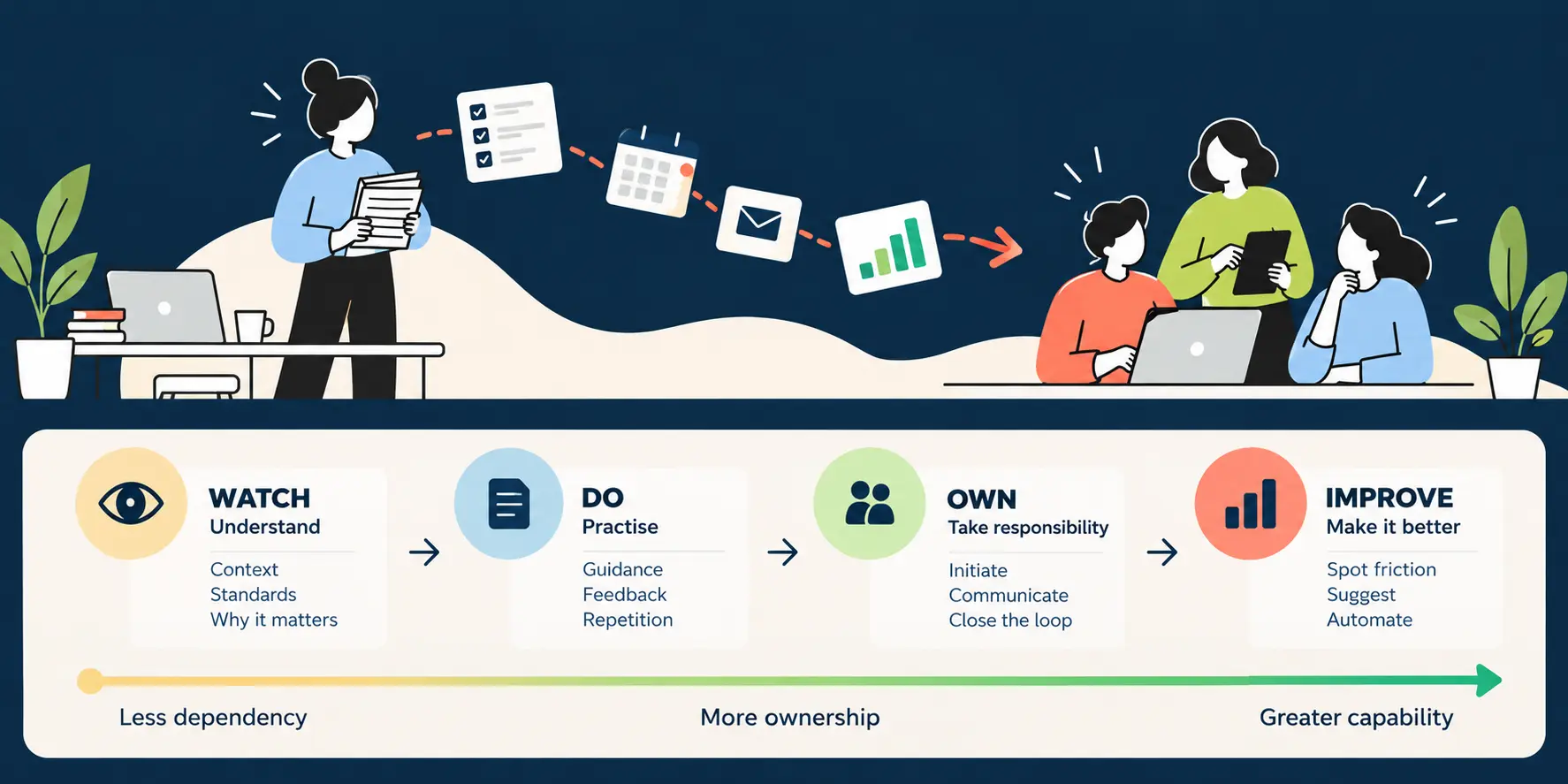
1. WATCH: Give them context before responsibility
Before someone can own the work, they need to understand it.
This is where many onboarding processes become too focused on instructions.
Click here.
Update this.
Send this every Friday.
Those instructions may teach someone how to complete the task.
They don't necessarily teach them why the task exists.
The better questions are:
- What outcome are we trying to create?
- Who depends on this work?
- What happens if it's late or wrong?
- What does excellent look like?
- What decisions can this person make?
- When should they escalate something?
- What tools and information will they need?
That context matters because eventually you want them to make sensible decisions when the exact situation isn't covered by an SOP.
During the WATCH stage, let them see how the work happens.
Show examples.
Explain decisions.
Give access to documentation.
Introduce the people they'll work with.
Let them ask questions.
You're not simply transferring instructions. You're transferring context.
2. DO: Let them perform the work with feedback
Eventually, watching has to become doing.
At this stage, the person begins performing the work while you provide guidance and feedback.
And this is where a little patience matters.
If you immediately take the work back every time something isn't done exactly as you would have done it, you're teaching the person that you are still the real owner.
Instead, create feedback loops.
- What was done well?
- What needs adjusting?
- Was the expectation clear?
- Did they have enough information?
- Was the problem a skill gap, a context gap or simply something they haven't encountered before?
The objective isn't perfection after one attempt.
It's reducing how much guidance is required each time the work repeats.
First:
“Here's how we do it.”
Then:
“Give it a try and I'll review it.”
Then:
“You've got it. Let me know if something unusual comes up.”
That's progress.
3. OWN: Move the mental load, not just the task
This is the stage businesses are usually trying to reach when they say they want to delegate.
Ownership means the person doesn't need you to initiate the recurring work.
They know when it needs to happen.
They understand the expected outcome.
They follow up with the people involved.
They notice when something is missing.
They communicate progress appropriately.
They escalate when a decision genuinely requires someone more senior.
And they close the loop.
That's very different from simply completing a task after someone tells you to do it.
Imagine a weekly marketing report.
Task delegation looks like:
“Can you prepare the report for Friday?”
Ownership looks more like:
The report happens every Friday.
The data has already been collected.
Missing information has been chased.
Anything unusual has been flagged.
The report is ready for the people who need it.
Nobody had to remember to ask for it.
That's when you've started transferring the mental load along with the work.
It is also the point where a hire begins adding capability rather than capacity alone.
Ownership doesn't mean silence
There's an important distinction here.
Someone who owns their work shouldn't disappear.
In fact, good ownership usually requires better communication.
You shouldn't need to chase them for updates.
They should know when an update is useful.
You shouldn't discover a problem after the deadline.
They should recognise when something needs escalating.
You shouldn't need to ask whether something was completed.
There should be enough visibility in your systems and communication that you already know.
Ownership isn't:
“Leave me alone. I've got it.”
It's:
“I've got it, and I'll make sure you have the visibility you need.”
4. IMPROVE: Give capable people room to make the work better
This is where a hire can begin creating much more value than the original task list suggested.
After someone has performed a process repeatedly, they often start seeing things you don't.
Why do we enter this information twice?
Why does this approval take three steps?
Why are we manually building this report every week?
Could this reminder be automated?
Does anyone actually use this spreadsheet?
Why does this task keep getting stuck with the same person?
Someone who understands the work and feels genuine ownership can start asking:
“Could we do this better?”
That doesn't mean every suggestion should automatically become a new process.
But you want people who feel comfortable identifying friction.
This becomes particularly valuable as AI and automation become part of everyday work.
A capable person who understands the process can evaluate where technology might remove repetitive work, organise information faster or create better visibility.
Now they aren't simply operating the system.
They're helping strengthen it.
SOPs help. But documentation alone doesn't create ownership.
Good documentation matters enormously in distributed teams.
Processes shouldn't live entirely inside someone's head.
But an SOP can't anticipate every situation.
If onboarding consists entirely of:
Here's the documentation. Follow it.
you may create someone who is very good at following instructions.
You haven't necessarily created someone who can exercise judgement.
Documentation should provide a foundation.
Then conversations, examples, feedback and experience add the context around it.
The goal is for someone to understand the process well enough that when reality doesn't perfectly match the document, they can recognise it and respond appropriately.
That's where capability starts showing up.
Give people the tools to succeed
Ownership also becomes difficult when the environment works against the person you're asking to take responsibility.
Imagine expecting someone to own client onboarding while they don't have access to the CRM.
Or asking someone to manage deadlines when nobody consistently updates the project management system.
Or expecting proactive communication when nobody has explained which channel should be used for what.
Before assuming someone lacks initiative, ask whether they actually have what they need.
That includes:
- AccessCan they reach the systems, information and people required to do the job?
- ClarityDo they understand their responsibilities and what success looks like?
- AuthorityDo they know which decisions they can make themselves?
- CommunicationDo they know what needs to be shared, when and with whom?
- ToolsDo they have the technology needed to perform the work effectively?
- FeedbackDo they know when they're doing well and where they need to improve?
Ownership works best when expectations and infrastructure support it.
Don't accidentally train people to wait for you
Sometimes managers say they want initiative while unintentionally discouraging it.
Every decision requires approval.
Every mistake results in the work being taken back.
Every process change gets dismissed because “that's how we've always done it.”
Every question is answered immediately rather than helping the person learn how to find the answer.
Eventually, people learn the safest behaviour:
Wait for instructions.
If you want ownership, there has to be enough room for someone to exercise it.
That doesn't mean giving unlimited autonomy.
It means creating clear boundaries.
You can decide this.
Check with me before doing that.
If this happens, escalate immediately.
Those boundaries actually make independent work easier because the person understands where their authority begins and ends.
Offshore shouldn't mean outside the team
There's another reason this matters particularly in global teams.
If your offshore professional is treated as an external pair of hands rather than part of the operation, don't be surprised if they behave like one.
Ownership is difficult when someone receives tasks without context, isn't included in relevant conversations and has little visibility into the goals behind their work.
You don't need everyone in every meeting.
But people should understand how their work contributes to the wider business.
The strongest global teams aren't necessarily the ones with the most meetings or the most documentation.
They're the ones where people understand:
This is what we're trying to achieve.
This is the part I own.
This is how my work connects to everyone else's.
That's when geography starts mattering a lot less.
This is also why training shouldn't stop at tools
When we think about preparing professionals for global work, technical skills matter.
People need to understand the systems they'll use.
But we've become increasingly interested in the capabilities around those tools too:
communication,
ownership,
working across cultures,
using AI responsibly,
project management,
documentation,
and understanding how to operate inside an international team.
That's part of the thinking behind the way we're developing talent through Sapphire LaunchPad.
The objective isn't to teach people a collection of software.
It's to help professionals become more capable of succeeding in the environment they're entering.
Because knowing how to use a project management tool is useful.
Knowing how to own a project is considerably more valuable.
Your offshore hire should still need you sometimes
The goal isn't to make yourself completely unnecessary.
There will always be decisions that require leadership.
Priorities change.
Clients surprise you.
Problems happen.
People need coaching.
Strategy evolves.
Good team members ask questions.
And sometimes the correct decision is to escalate something rather than solve it independently.
The difference is that you shouldn't remain responsible for initiating and driving every piece of recurring work they were hired to own.
You move from:
“Did you do this?”
to:
“Here's what we're trying to achieve next.”
That's a much better use of everyone's time.
Build towards ownership from the beginning
When you're hiring someone, don't only think about what you want them doing in Week 1.
Think about what you want them owning in Month 6.
Ask:
- What should happen without me reminding them?
- What decisions should they eventually make independently?
- What information should they proactively communicate?
- What problems should they be able to solve?
- What systems should they understand?
- What could they eventually help us improve?
Those answers should shape the role, the onboarding and the way you manage the person.
Because the goal isn't simply to get tasks off your plate.
It's to build a business where capable people can carry meaningful responsibility with you.
That's how adding another person begins creating real leverage.
Built in the Philippines. Experienced globally.