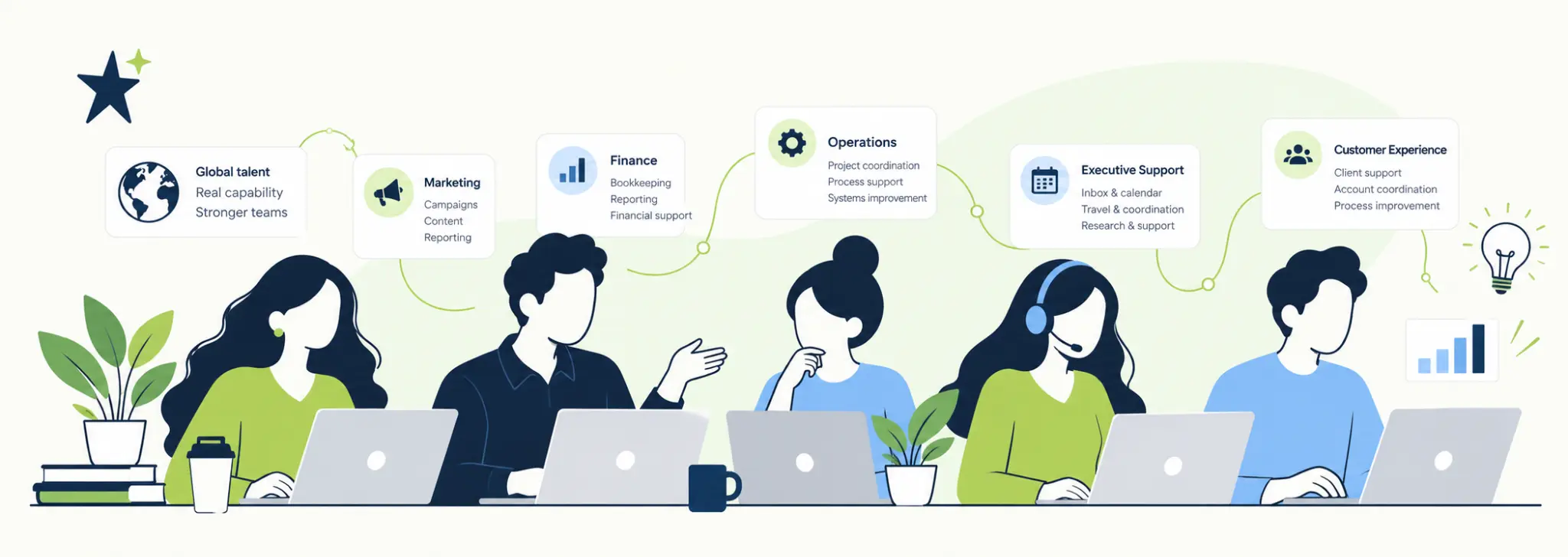
There is absolutely nothing wrong with being a Virtual Assistant.
It is a real role. It requires real skills. And a great VA can create enormous value for a business.
But somewhere along the way, “VA” became a catch-all term for almost anyone working remotely from the Philippines.
A marketer becomes a VA.
A bookkeeper becomes a VA.
An operations professional becomes a VA.
A designer becomes a VA.
An analyst becomes a VA.
An experienced executive assistant becomes a VA.
And that raises a question worth asking:
If you hired the exact same person locally, would you still call them a VA?
Because working remotely is a way of working.
It isn't a profession.
Remote is a location. Capability is the value.
Imagine hiring someone with six years of marketing experience.
They understand CRM systems. They can coordinate campaigns, interpret reports, manage deadlines, work with creative teams and identify when something isn't working.
If that person worked in your office, you might call them a Marketing Operations Specialist.
If they worked remotely from another city in your own country, you might still call them a Marketing Operations Specialist.
So why should moving their desk to the Philippines suddenly turn them into a VA?
It shouldn't.
The same applies to finance professionals, operations coordinators, customer support specialists, designers, analysts and many other skilled professionals working remotely around the world.
Their location hasn't erased their experience.
Yet when businesses automatically categorise offshore professionals as VAs, they can unintentionally limit what they expect from them.
And expectations influence how we hire, manage and develop people.
“I need a VA” might be the wrong place to start
When a business owner becomes overwhelmed, it's understandable to think:
I need a VA.
But that statement doesn't actually tell us very much about what the business needs.
What is taking up your time?
What isn't getting done?
Where are things constantly getting stuck?
What capability is missing?
Perhaps your marketing campaigns need someone to keep execution moving.
Perhaps customer enquiries aren't being followed through consistently.
Perhaps projects need stronger coordination.
Perhaps your financial information needs to be organised into useful reporting.
Perhaps your CRM has become a graveyard of leads nobody is managing.
Those are very different problems.
And they may require very different professionals.
When everything gets grouped under the word “VA”, businesses risk hiring backwards:
Budget → VA → list of tasks → find someone
Instead of:
Business gap → capability needed → responsibilities → right professional
The second approach opens up a much bigger talent pool.
If you're already going thousands of miles, why stop at basic support?
There is something slightly strange about being willing to search halfway around the world for talent and then limiting that search to the lowest-hanging tasks in the business.
If geography is no longer the boundary, why should capability be?
If your business needs stronger marketing execution, you can look for an experienced marketing professional.
If you need better operational coordination, you can look for someone who understands operations.
If you need better visibility over your numbers, you can look for someone with finance and reporting experience.
The Philippines has professionals who have spent years working inside local and international businesses, using many of the same platforms, systems and processes used by companies elsewhere in the world.
The opportunity isn't simply to find someone who can take tasks away from you.
It's to find someone who can bring a capability your business needs.
This matters even more in the age of AI
Businesses everywhere are currently asking versions of the same questions:
How should we use AI?
What can we automate?
Which tools should our team be using?
How can we become more productive?
What skills will matter next?
But there's another question worth asking:
Do you actually understand the capability of the people you're hiring remotely?
Because businesses cannot seriously prepare for an AI-enabled future while continuing to look at global talent entirely through a pre-AI lens.
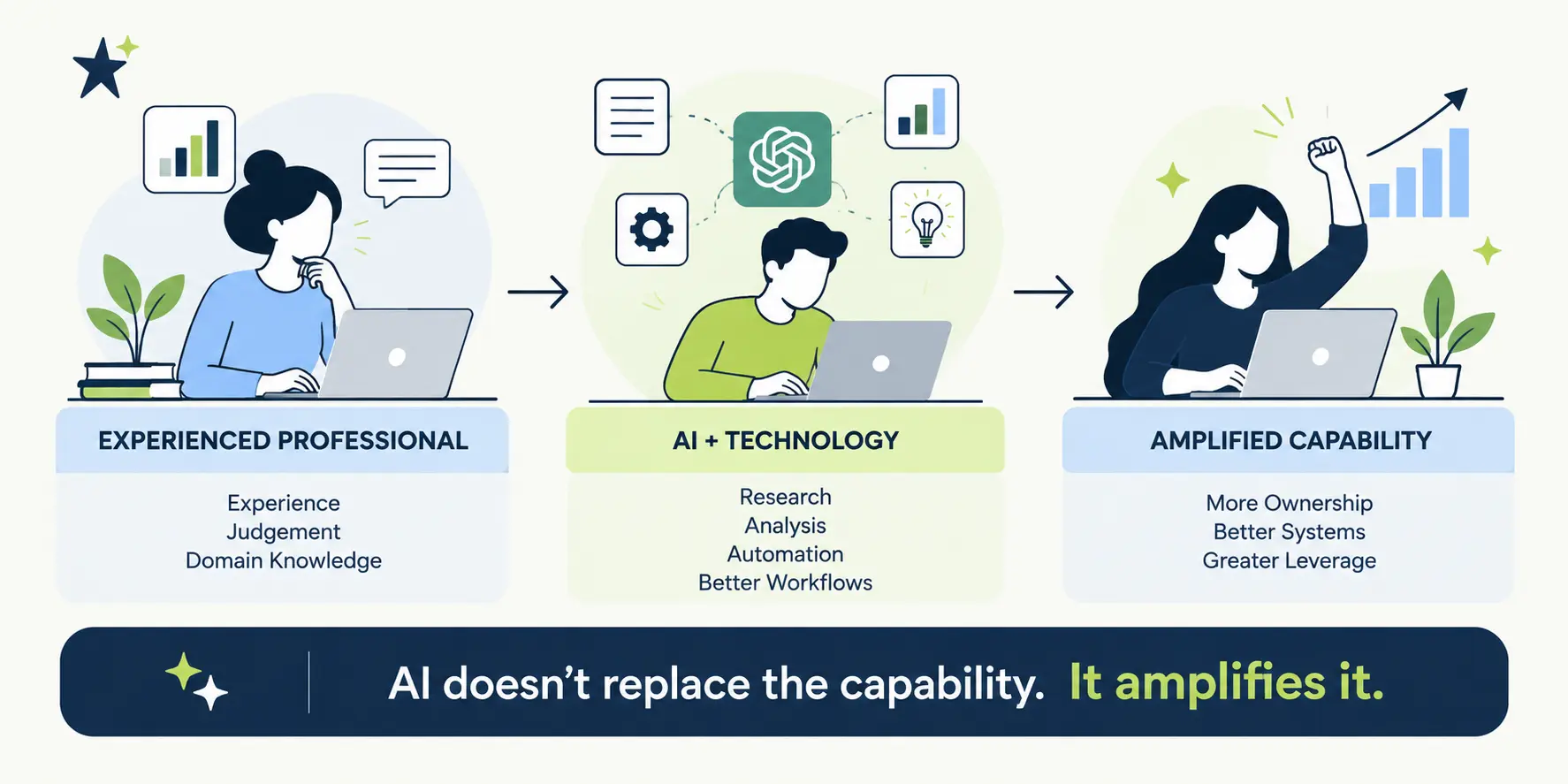
AI has changed what one capable professional can accomplish.
Take someone who already understands marketing, operations, finance, customer experience or another professional discipline.
Now give them access to AI.
Give them good technology.
Give them business context.
Give them clear outcomes.
And give them enough trust to think.
Suddenly, that person can potentially research faster, analyse information, document processes, automate repetitive work, create better workflows, communicate more effectively and identify opportunities for improvement.
AI isn't the capability by itself.
The experienced person is still the capability. AI gives that person leverage.
That combination is what makes AI-ready offshore talent so valuable to a growing business.
The opportunity is bigger than task delegation
For years, much of the outsourcing conversation has focused on tasks.
What can I delegate?
What can someone else take off my plate?
What can be done cheaper somewhere else?
Those questions aren't necessarily wrong.
But they are increasingly incomplete.
A more interesting question is:
What could my business become capable of with the right person in this role?
That changes the hiring conversation.
Instead of finding someone to update the CRM, you might find someone capable of eventually owning CRM hygiene and lead management.
Instead of finding someone to pull numbers into a spreadsheet, you might find someone capable of maintaining recurring reporting and surfacing useful information.
Instead of finding someone to chase project updates, you might find someone capable of coordinating the workflow and making sure things keep moving.
The task may be where someone starts.
Ownership is where the leverage begins.
AI doesn't make experienced people less valuable
There is understandable concern about what AI means for jobs.
But there is another side of that conversation.
AI can also make capable people considerably more capable.
Someone with experience already has something AI doesn't automatically provide: context.
They understand customers.
They understand what good work looks like.
They recognise when something doesn't make sense.
They've seen problems before.
They understand the consequences of decisions.
Combine that experience with the ability to use AI effectively, and the opportunity becomes much more interesting than simply automating a task.
The future of work may not just belong to people who know how to use AI.
It may belong to people who can combine experience, judgement, adaptability and AI to produce better outcomes.
And those people can live anywhere.
Offshore shouldn't mean outside the team
There is another mindset worth leaving behind.
Someone being offshore doesn't mean they should sit outside the real business.
If you want people to take ownership, they need context.
They need to understand what the business is trying to achieve.
They need access to the information and tools required to do their job.
They need communication.
They need feedback.
And they need to feel that their ideas are welcome.
You cannot hire someone for their capability and then create an environment where they're only allowed to follow instructions.
That wastes the very thing you hired them for.
The goal should not be to build a team of people waiting for tasks from the other side of the world.
It should be to build one team with clearly owned responsibilities, regardless of where everyone happens to sit.
Hire a VA when you need a VA
None of this means businesses should stop hiring Virtual Assistants.
Quite the opposite.
If what your business needs is a great VA, hire a great VA.
If you need an Executive Assistant, hire an Executive Assistant.
If you need a Marketing Operations Specialist, hire one.
If you need a Finance Operations Coordinator, hire one.
If you need a Customer Support Specialist, hire one.
The point is simply to stop allowing someone's geography to define their profession.
Because when we do, we risk overlooking years of experience, specialist knowledge and potential contribution.
Look for the capability, then look for the person
Global hiring gives SMEs access to something businesses of previous generations could barely imagine:
a worldwide talent market.
That's a remarkable advantage.
But we won't get the full value from it if we continue putting skilled professionals into the same box simply because they work remotely.
So if you're already willing to go the extra thousand miles to find the support your business needs, go a little further in how you think about the role.
Don't start with:
“What can I give to a VA?”
Start with:
“What capability is my business missing?”
Then find the right person to bring it.
Wherever in the world they happen to be.
Remote is a location. Capability is the value.